
The institutions AI will need: notes from class
Teaching AI futures at Columbia University

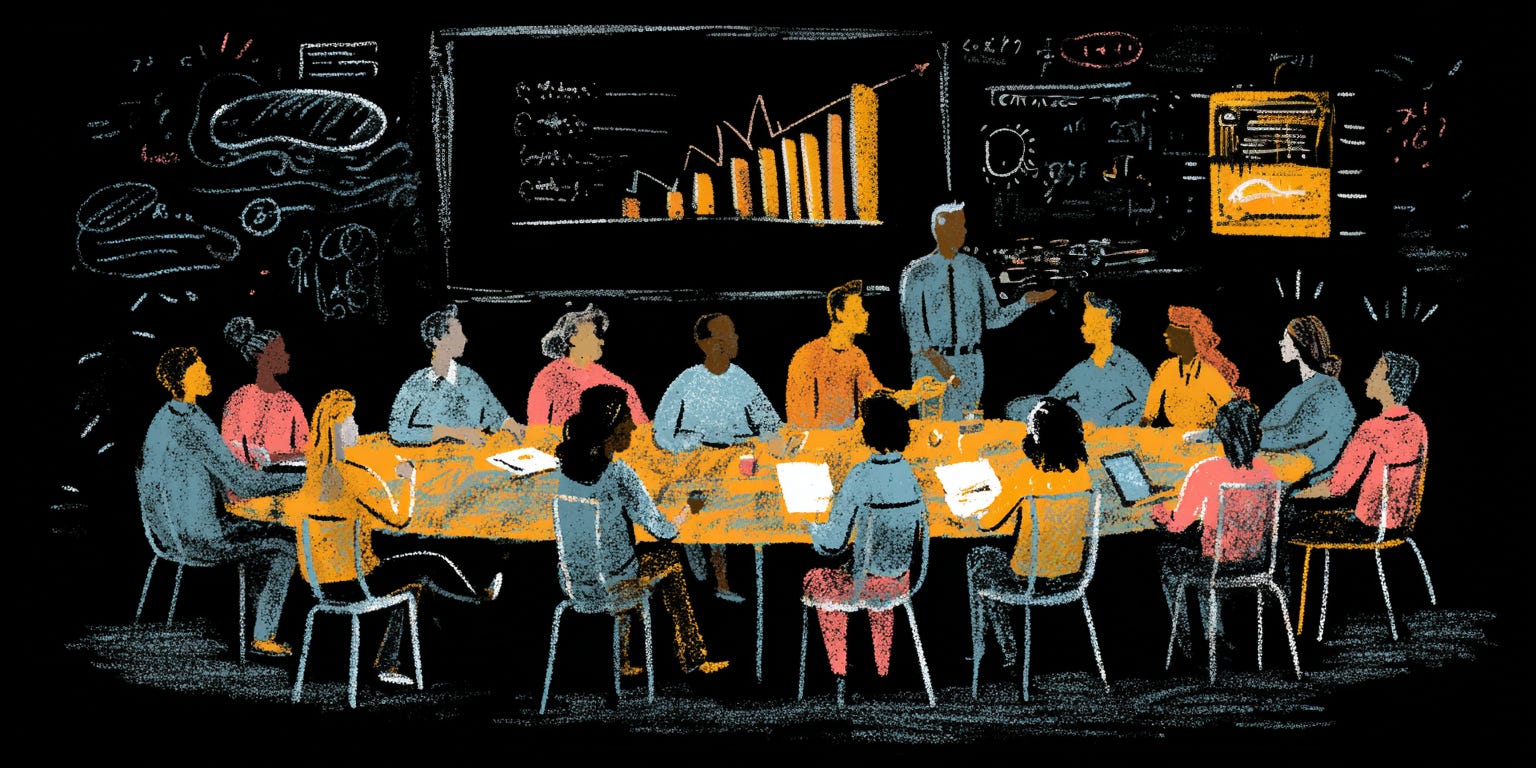
I just finished teaching my course on AI futures (Our AI Future; DSPC IA7175, formerly AI Institutions) for the second year at Columbia University’s School of International and Public Affairs (SIPA), for Master’s in Public Administration students.
Here’s the course description:
AI is rewriting the rules of society. This course invites you to understand and shape what comes next. We begin by turning the classroom into a living experiment on how AI could change education, then examine how abundant intelligence could reshape work, governance, and transportation. In a field often dominated by speculation, we will ground our discussions in evidence and theory. Together, we’ll explore what institutions are needed for a world transformed by intelligence.
The economic and social implications of AI will not be figured out solely by computer scientists in the labs. They will be figured out across society, by the entrepreneurs and tinkerers who see a bit ahead. I don’t have the answers, but my aim is to equip students to see further ahead, by helping them reason about what is coming. We read technical papers (scaling laws and on AI capabilities), emerging evidence on AI impacts, evidence from historical precedents (steam engines and electrification), and conceptual pieces.
The syllabus is here. (If you’re considering taking my course at SIPA, there are spoilers ahead.)
Principles
The course is designed on a few principles:
AI allows, and may require, that we redesign institutions. Most discourse considers how AI may be grafted on to existing jobs, industries, laws, and government agencies. This class considers how these systems might be reshaped.
We need both data and imagination. We combine guided speculation from theory and conceptual pieces, with evidence based on hard data. There’s a mismatch between the type of rigor prized in most academic work, which leads to carefully measured estimates that are out of date, and the forward looking guidance that is needed to understand our changing world. I used the class as a vehicle to think about this gap, and published some of my thinking as an essay in Nature.
Education is a laboratory for the impacts of AI. I begin the course by acknowledging that that AI has expanded students’ capabilities, so what they are asked to deliver must also expand. Their first assignment is to propose a set of assignments for the course, to achieve learning and impact. In our second class session, we settle on a set of assignments. Deciding these assignments is always contentious: some want the traditional memo assignments to which they have become accustomed, many are wary of technical assignments, and many are wary of signing up for a class with uncertain deliverables. It’s chaos. That chaos is by design. At the end of the debate, I remind students that we will be considering a series of domains that have a status quo that may be disrupted by AI. In each of those domains, people will find their world shaken—we must respect how it feels.
AI progress raises standards. Submissions are graded relative to what AI could produce. Last year, students chose to write memos on the readings. Halfway through the semester, I confronted the class with the fact that AI capabilities had increased. We graded two example memos together (incidentally generated by AI), and realized that student memos no longer exceeded in quality those that could be written by AI. That is an economic problem: an employer may not pay them $100/hr to produce insight that a computer could do for $0.01. The main change this year was to produce demos of minimum viable products.
Reflections
Students found a few moments particularly provocative:
Is the potato a general purpose technology? Nathan Nunn and Nancy Qian’s work finds that its introduction from the Americas accounted for one quarter of population growth in the Old World between 1700 and 1900. The potato is a technology that reshaped society. Does it matter whether a technology is a GPT?
Should self-driving cars respect local values? Nigerian respondents to the Moral Machine are more willing to spare higher status individuals, Chinese respondents are less willing to spare the young, and Americans are more willing than others to sacrifice human lives to spare animals. Who should decide these tradeoffs?
Today’s AI policies will look quaint. Early airplanes did not have good navigation systems, so the U.S. built a network of giant concrete arrows that pilots could follow by looking down. Innovations to navigation made this stopgap obsolete. Our adaptations to AI will also go through multiple phases, and problems that appear severe today may find solutions we have yet to imagine. What are the stopgaps, and what are the supporting innovations?
Visualizing the scale of modern AI systems. Visually relating the simple quantitative models students have used in statistics classes to the structure of LLMs is striking.
We were grateful for a guest visit by Séb Krier of Google DeepMind, with a rich Q&A about AGI timelines and the role of policy.
I have now taught the class over two consecutive years. A few things have changed:
Students are no longer skeptics. Last year, about half of my students were optimistic about AI, and half were skeptics. This year, nearly all of my students believe AI will transform society. They want to navigate that transformation.
Students are capable of much more. Last year, two students built compelling demos for their final projects. This year, all students—even those with zero experience coding—built creative and interesting software projects. It’s a new world.
Most economic and social changes are still yet to come. I kept much of the same material on economic principles, as it remained relevant. We are likely to be surprised by changes that have yet to come.
What students built
My students built creative demos! Here are a few:
Policy conflict radar: anticipate political issues before they arise, based on how AI personas react to current events, by Sewon Sunwoo.
Pathwise: assess whether your career path is exposed to AI, and get suggestions on how to pivot, by Karina Lages de Altavila.
Resolve: write up the details of a dispute, then learn your rights and how to navigate the legal system, by Hani Iqbal and Ali Serdar
SafeScroll: decide what content you see on the web using nuanced controls, for example blurring show spoilers, by Navya Sinha.
It has been an honor to think about our future with my students. I’m excited to see what they build next.
This piece was originally posted on Daniel Björkegren’s Blog.